
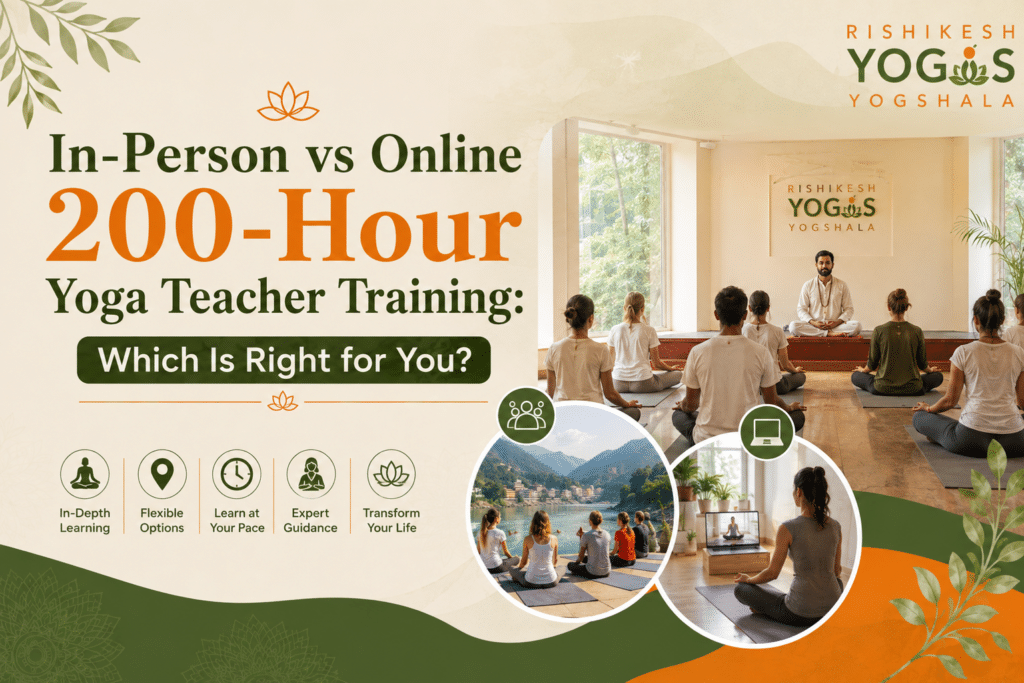
If you’re deciding between an in-person and an online 200-Hour Yoga Teacher Training, the honest answer is that both lead to the same Yoga Alliance certification — but the experience of getting there is genuinely different, and the right choice depends less on convenience and more on what you actually need from the training.
This is one of the most common questions we get from prospective students, and it’s a good one, because the two formats really do produce different kinds of teachers, even when the certificate at the end looks identical on paper. Understanding what actually changes between the two — not just the obvious travel-versus-no-travel difference — will help you make a decision you won’t second-guess halfway through your training.
What Stays the Same
Both formats cover the same core curriculum: asana, pranayama, meditation, yogic philosophy, anatomy, and teaching methodology. Both are built to Yoga Alliance’s 200-hour standard, and both result in the same internationally recognized certification. The difference isn’t in what you learn — it’s in how you learn it, how deeply you absorb it, and what kind of teacher it shapes you into by the end.
Course structure is also broadly similar in terms of content sequencing: foundational postures and breathing techniques early, building toward teaching methodology, sequencing, and practicum teaching hours by the final weeks. Whichever format you choose, you’ll walk through the same overall arc.
Where In-Person Training Wins
- Hands-on adjustment — a teacher physically correcting your alignment is difficult to replicate through a screen, and this kind of tactile feedback is often where the deepest learning happens.
- Immersion — living, practicing, and eating alongside your cohort for a month builds a different depth of practice than fitting classes around a normal week. There’s no “pausing” an in-person course to answer emails.
- Environment — practicing in Rishikesh, on the Ganga, in the Himalayan foothills, is part of the experience for many students, not incidental to it. The setting itself does some of the teaching.
- Community — you finish the course with a cohort of people who went through the same intensive experience, which often becomes a genuine support network once you start teaching.
- Immediate feedback loops — questions get answered in real time, in person, often demonstrated on your own body rather than described in a chat window.
Where Online Training Wins
- Flexibility — you can study around work, family, or a schedule that doesn’t allow four weeks away from home.
- Cost — no flights, no accommodation, no time off work to budget for, which meaningfully lowers the total cost of certification.
- Lower barrier to starting — useful if you’re not yet certain you want to commit to travel before knowing if teacher training is right for you at all.
- Self-paced structure — pre-recorded material means you can revisit a difficult concept as many times as you need, something you don’t get in a live, moving-forward in-person schedule.
- Accessibility — for students managing health conditions, caregiving responsibilities, or visa complications, online training removes barriers that would otherwise put certification out of reach entirely.
What a Typical Week Looks Like in Each Format
In-person, your day is structured around the school’s schedule: early morning pranayama, asana practice, philosophy lectures, teaching methodology sessions, and evening reflection or discussion groups, six days a week. There’s very little unstructured time, which is intentional — the immersion is the point.
Online, your week is self-directed. You work through pre-recorded modules at your own pace, typically with scheduled live sessions for Q&A, practicum feedback, and group discussion. This suits students who learn well independently, but it does require more self-discipline, since there’s no built-in structure pulling you back into the material the way a physical classroom does.
Cost Differences Worth Knowing
Online programs are generally less expensive than in-person training once you account for the full picture — not just tuition, but flights, visa costs, and a month of accommodation and meals that in-person students need to budget for on top of the course fee. For students weighing cost heavily, this is often the deciding factor, even when they’d genuinely prefer the in-person experience.
Who Should Choose Which
If your goal is to eventually teach in a studio setting and you want the confidence that comes from hands-on correction and a full immersion experience, in-person training in Rishikesh is worth the trip. If you’re balancing training around a job you’re not ready to leave, or you want to test your commitment to teaching before a bigger investment, the online 200-Hour program covers the same certification without the travel.
Some students also treat online training as a first step — completing the 200-Hour program remotely, then returning in person for a 300-Hour or 500-Hour course later, once they’ve confirmed teaching is a path they want to commit to further. There’s no wrong order here, only the sequence that fits your circumstances.
FAQs
Do both formats give the same certification?
Yes — both the in-person and online 200-Hour programs are Yoga Alliance certified at the same 200-hour standard.
Can I switch from online to in-person training later?
Many students do exactly this, completing their 200-Hour certification online and later returning for a 300-Hour or 500-Hour in-person program to deepen their practice.
Is online training taken as seriously by employers or studios?
Yoga Alliance certification doesn’t distinguish between formats on the certificate itself, though some studios may ask about your training experience directly — it’s worth being upfront about which format you completed.