
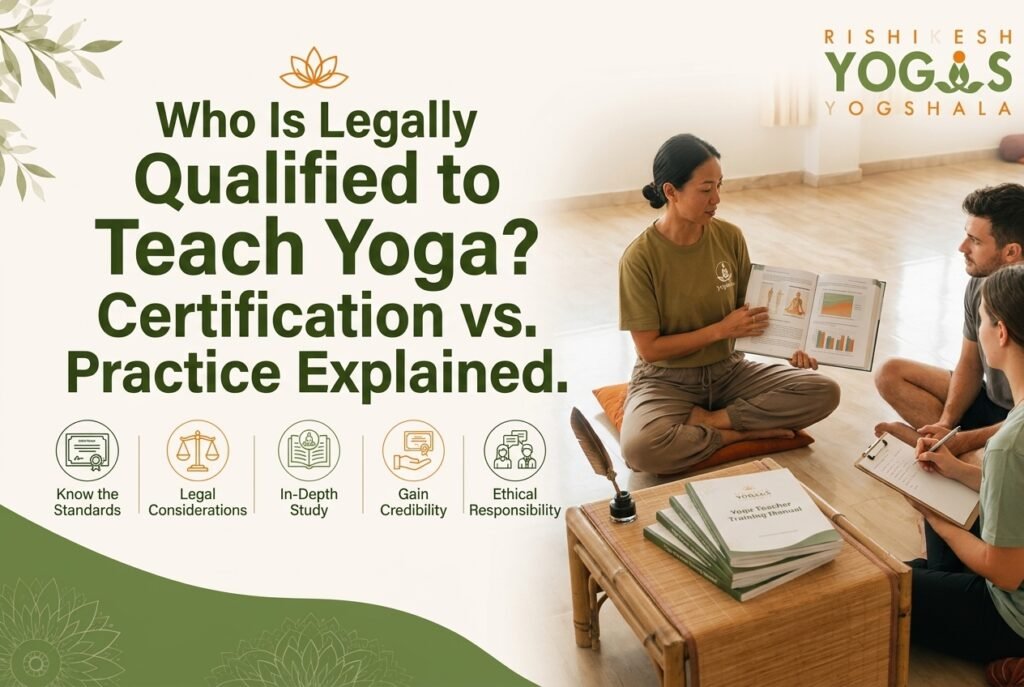
This is a question we get from prospective students fairly often, usually phrased some version of: “Do I need to already be good at yoga to teach it?” The short answer is no — what you need is proper training and certification, not years of prior practice. It’s worth unpacking this properly, because the confusion between skill and qualification stops a lot of genuinely capable future teachers from ever enrolling.
Is There a Legal Requirement to Teach Yoga?
In most countries, there’s no government-mandated license required to teach yoga the way there might be for, say, a medical profession. What functions as the industry standard instead is certification through a recognized body like Yoga Alliance, which most studios, gyms, and retreat centers require before hiring a teacher or accepting a freelance instructor.
This means the real gatekeeper isn’t government regulation — it’s the expectations of employers, insurers, and increasingly, students themselves, who often specifically look for a certified teacher before booking a class or workshop.
What Yoga Alliance Certification Actually Verifies
A Yoga Alliance certified 200-Hour, 300-Hour, or 500-Hour program confirms that you’ve completed a structured curriculum covering asana, anatomy, teaching methodology, philosophy, and practicum teaching hours — not just that you can perform advanced poses yourself. Being a skilled practitioner and being a good teacher are related but different skills, and certification programs are built specifically to teach the second one.
Practicum hours, in particular, are often underestimated by prospective students — this is the part of training where you actually teach, under observation, and get direct feedback on how you cue, sequence, and manage a class. It’s arguably the most valuable part of the certification, more than any single pose you learn to perform yourself.
Do You Need Prior Experience to Enroll?
No. Most 100-Hour and 200-Hour programs, including ours, are designed to take complete beginners through to a teaching-ready certification. You don’t need years of practice beforehand — you need commitment to the training itself, which is structured to build you up from foundational postures through to full teaching competency.
This surprises a lot of prospective students, who assume they need to be advanced practitioners before they’d even be considered for a teacher training program. In reality, schools that only accept advanced practitioners are the exception, not the rule, particularly for 100-Hour and 200-Hour entry-level programs.
What Studios and Employers Actually Look For
Most studios ask for proof of a Yoga Alliance certified 200-Hour minimum before hiring, sometimes preferring 300-Hour or above for more senior or specialized roles. The certificate itself, along with the reputation of the school that issued it, tends to matter more to employers than how long you’d been personally practicing before you enrolled.
Certification vs. Ongoing Practice
It’s worth being clear that certification is a starting point, not an endpoint. Most working yoga teachers continue developing their practice and teaching skill well beyond their initial 200-Hour certification, often returning for 300-Hour or 500-Hour training, workshops, or specialized certifications in areas like prenatal yoga, yoga therapy, or sound healing as their teaching career progresses.
Certification qualifies you to begin teaching professionally — it doesn’t mean your development as a teacher stops there, any more than a university degree means someone’s learning stops the day they graduate.
International Variations in Requirements
While certification standards through Yoga Alliance are broadly consistent internationally, some countries or regions do have additional local requirements — certain insurance providers, gyms, or corporate wellness programs may ask for specific liability coverage or local registration alongside your teaching certificate. It’s worth checking what’s specifically expected in the country and setting where you plan to teach, rather than assuming your certification alone covers every requirement everywhere.
Insurance and Liability Considerations
Once certified, most professional yoga teachers carry liability insurance, which is often a requirement for teaching at an established studio or gym, even though it’s separate from your teaching certification itself. This is worth researching early, ideally before you start actively teaching, since it protects both you and your students in the event of an injury during a class.
Building Confidence Beyond the Certificate
Certification gives you the qualification to teach, but confidence in the classroom tends to come from experience — the practicum teaching hours built into a good 200-Hour program, followed by real teaching once you graduate. Many new teachers find their first few months of actually teaching classes more formative to their development than any single week of their original training, which is a normal and expected part of growing into the role.
If you’re weighing whether you’re “ready” to enroll in a teacher training, it’s worth reframing the question: readiness for a 200-Hour program isn’t about your current skill level, it’s about your willingness to commit fully to a structured month of learning. The certification and the confidence both come from completing the training itself, not from arriving already prepared.
FAQs
Do I need prior yoga experience to enroll in a 200-Hour YTT?
No — most 200-Hour programs are designed to take complete beginners through to teaching-ready certification.
Is Yoga Alliance certification legally required to teach?
There’s generally no government license required to teach yoga in most countries, but Yoga Alliance certification is the industry-standard credential most studios and employers require.
What’s the difference between being good at yoga and being certified to teach it?
Personal practice ability and teaching skill are related but distinct — certification programs are specifically structured to build teaching methodology, anatomy knowledge, and practicum experience, not just physical skill.