If you’ve spent any time researching yoga and wellness training recently, you’ve likely come across sound healing — it’s one of the fastest-growing additions to yoga and meditation programs, and it’s worth understanding even if you’re not planning to specialize in it, since it’s increasingly showing up as a complement to standard Yoga Teacher Training curricula across Rishikesh.
What Sound Healing Actually Is
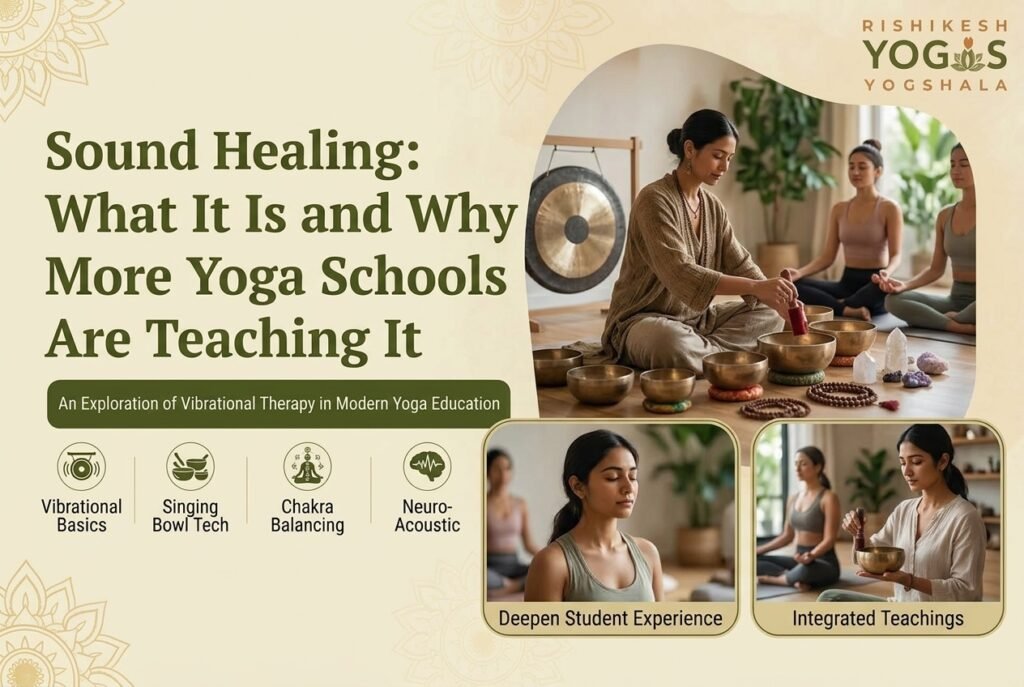
Sound healing uses instruments like singing bowls, gongs, tuning forks, and chanting to produce vibrations and frequencies intended to support relaxation and a meditative state. The practice draws on the idea that sound and vibration can help shift the body and mind out of a stressed state and into a more restful one — similar in goal to guided meditation, but using sound rather than instruction as the primary tool.
A typical sound healing session, often called a “sound bath,” involves lying down comfortably while a practitioner plays a sequence of instruments around and near you. There’s no physical activity required from participants — the experience is entirely receptive, which is part of what distinguishes it from most other yoga-adjacent practices.
How It Connects to Yoga Practice
Sound has actually been part of yogic tradition for a long time — mantra chanting and the use of specific sound vibrations in meditation are well-established practices, not a new addition. What’s changed recently is that sound healing has developed into its own more structured discipline, often taught as a standalone session or short course rather than only as a component within a broader yoga class.
Instruments like the Tibetan and crystal singing bowls now closely associated with sound healing draw on older traditions of using resonant sound for meditative and ceremonial purposes, adapted into a more accessible, secular format for a broader modern audience.
Why It’s Growing Now
Interest in sound healing has grown alongside broader interest in accessible, low-impact wellness practices — it requires no physical flexibility or fitness level, which makes it appealing to a wider range of people than physical yoga practice alone. Several established yoga schools in Rishikesh now offer sound healing sessions or short certification courses alongside their standard Yoga Teacher Training programs, reflecting genuine demand rather than a passing trend.
Part of the appeal is also practical: sound healing sessions are relatively simple to offer alongside an existing studio or retreat business, and growing consumer interest in stress-reduction and mental wellness practices has created real demand beyond the traditional yoga-practicing audience.
What a Sound Healing Session Typically Involves
- A quiet, comfortable space, usually with participants lying down on mats or cushions.
- A sequence of instruments played by a trained practitioner, often building gradually in intensity before tapering off.
- No physical postures or exertion required from participants.
- Sessions typically run anywhere from 30 minutes to over an hour, depending on the format.
Is It Right for You?
If you’re drawn to the meditative and philosophical side of yoga more than the physical practice, sound healing is worth exploring, either as a standalone interest or as a complement to a broader Yoga Teacher Training. It’s also accessible to complete beginners, since no prior yoga experience is required to attend a sound healing session.
For teacher trainees specifically, understanding sound healing — even without specializing in it — adds another tool to your teaching vocabulary, particularly useful for closing sequences, restorative classes, or students dealing with high stress or anxiety.
The Science and Skepticism Around Sound Healing
It’s worth being straightforward about this: research into sound healing’s physiological effects is still developing, and much of the current evidence is based on self-reported relaxation and stress reduction rather than rigorously established clinical outcomes. That doesn’t make the practice worthless — subjective relaxation and stress relief are genuinely valuable on their own terms — but it does mean sound healing is best approached as a complementary wellness practice, not a medical treatment.
How to Find a Qualified Practitioner
As sound healing has grown in popularity, so has variation in the quality and depth of training among practitioners. When looking for a sound healing session or short course, ask specifically about the practitioner’s training background and how long they’ve been practicing, the same way you would evaluate any wellness instructor. A practitioner trained through a reputable school with a structured curriculum will generally offer a more grounded, consistent experience than one who’s picked up the practice informally.
If you’re specifically interested in adding sound healing to your own teaching toolkit, look for programs that combine hands-on instrument training with an understanding of how and when to safely incorporate sound work into a broader yoga or meditation class.
Whether you approach it as a personal practice or a future teaching specialty, sound healing is a good example of how the wellness space continues to evolve around yoga’s traditional core — worth understanding as part of a broader, current view of the industry, even if it never becomes your primary focus.
FAQs
Do I need yoga experience to try sound healing?
No — sound healing sessions are typically accessible to complete beginners, since it doesn’t require physical yoga postures or prior practice.
Is sound healing part of traditional yoga philosophy?
The use of sound and mantra in meditation has long been part of yogic tradition; sound healing as a standalone modern practice builds on that foundation with a more structured, instrument-focused approach.
Is sound healing scientifically proven?
Research on sound healing is still developing, and results are generally reported as subjective relaxation and stress-reduction benefits rather than clinically established medical outcomes — it’s best approached as a complementary wellness practice.