
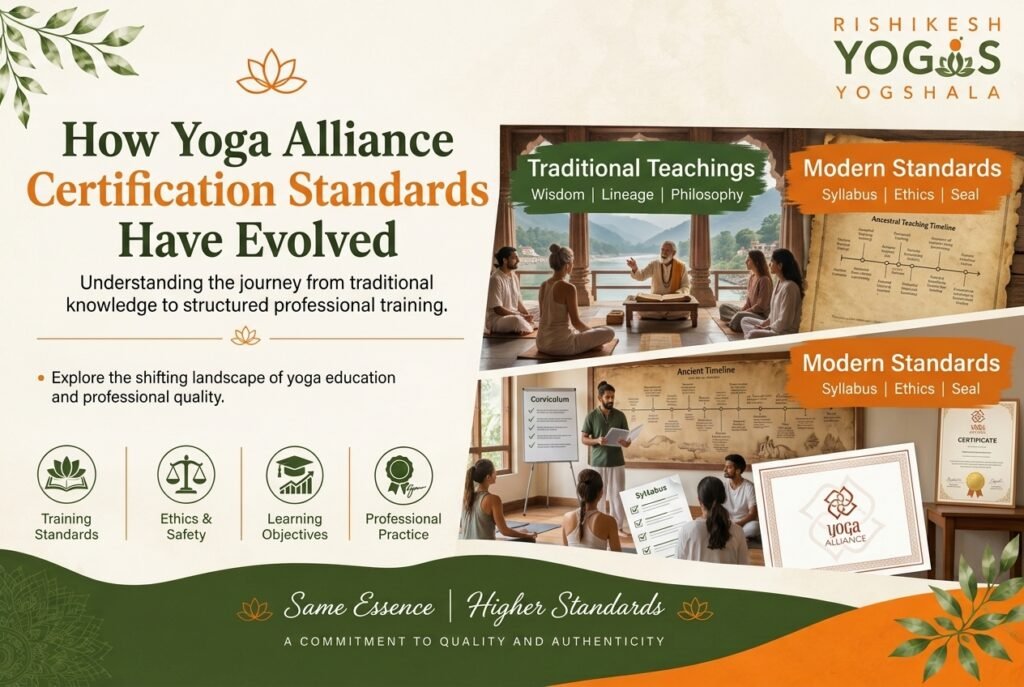
Yoga Alliance certification is the credential most studios and employers look for, but the standards behind that certification aren’t static — they’ve evolved over time as the yoga industry itself has grown and matured. Understanding how helps explain why certification quality varies between schools, even when they’re all technically “accredited.”
Why Standards Needed to Evolve
As yoga teacher training exploded in popularity globally, the range of programs claiming certification grew enormously — from serious, traditionally grounded schools to much lighter, less rigorous courses. Evolving standards have been, in large part, a response to this growth: an effort to keep the credential meaningful as the number of certified schools multiplied around the world.
What’s Generally Changed
- Greater emphasis on practicum teaching hours — actual supervised teaching experience, not just theoretical knowledge.
- More structured requirements around anatomy and safety training, reflecting growing awareness of injury risk in poorly taught classes.
- Increased attention to teaching methodology as its own subject, rather than assuming strong personal practice automatically translates into strong teaching.
- More defined continuing education expectations for teachers maintaining their credential over time, not just at initial certification.
What This Means for a Current 200-Hour Program
A Yoga Alliance certified 200-Hour program today is generally expected to cover a well-rounded curriculum — asana, pranayama, anatomy, teaching methodology, philosophy, and supervised practicum teaching — not just physical practice with a light theoretical add-on. This is worth knowing specifically because it means the credential itself carries more structured meaning today than a casual observer might assume.
Why This Matters When Choosing a School
Not every school that advertises “Yoga Alliance certified” delivers the same depth of training, even when both are technically accredited. It’s worth asking a prospective school directly how their curriculum breaks down across these areas — how many hours go to practicum teaching, how anatomy is taught, whether philosophy is a substantial component or a token afternoon lecture. The accreditation is a floor, not a guarantee of depth beyond it.
How Accreditation Continues to Change
Standards bodies like Yoga Alliance continue to adjust requirements as the industry evolves further, including how they address newer training formats like online certification, which didn’t exist as a mainstream option when the standards were first established. This is a genuinely active, evolving area, which is part of why it’s worth checking current requirements directly with Yoga Alliance rather than relying on outdated general knowledge, including anything written here, if you need precise current specifics for a specific certification decision.
How This Affects Continuing Education for Teachers
Evolving standards haven’t only affected initial certification — many current frameworks also expect certified teachers to engage in ongoing continuing education to maintain their credential over time. This reflects a broader shift in how the industry views certification: not as a one-time achievement, but as the beginning of an ongoing professional development process, similar to how many other professional certifications work outside the yoga industry.
The Push Toward Greater Specialization
As baseline 200-Hour standards have become more consistent across accredited schools, a parallel trend has emerged: growing demand for more specialized advanced certifications — prenatal yoga, yoga therapy, trauma-informed teaching, and similar focused credentials layered on top of a foundational 200-Hour certification. This reflects an industry maturing beyond a single generic credential toward more differentiated teaching specialties, similar to how many professions develop sub-specializations as they grow.
What Prospective Students Should Take From This
If you’re comparing schools, it’s worth asking directly how recently their curriculum has been reviewed or updated against current standards, not just whether they hold accreditation at all. A school that’s actively kept pace with evolving expectations — more practicum hours, stronger anatomy and safety training, structured methodology — is likely to deliver a meaningfully stronger foundation than one running an unchanged curriculum from years earlier, even if both hold the same underlying accreditation.
It’s a reasonable, entirely fair question to ask any prospective school directly, and a school confident in its own curriculum should be able to answer it clearly — hesitancy or vagueness in response is itself useful information when you’re comparing multiple options.
Looking Ahead: Where Standards May Continue to Shift
Given how much the certification landscape has already changed — growth in online training formats, greater specialization, more structured continuing education — it’s reasonable to expect further evolution ahead, particularly as the industry continues to professionalize. Staying informed about these shifts is genuinely useful, whether you’re a prospective student choosing a program now or a certified teacher planning your own ongoing development over the years ahead.
We keep our own curriculum under regular review for exactly this reason, and we’re always happy to walk prospective students through how our program reflects current standards if that’s something you’d like to understand before enrolling.
It’s a small extra step in your research, but a genuinely worthwhile one.
FAQs
Does an older Yoga Alliance certification become invalid as standards change?
No — certifications generally remain valid once issued, though ongoing continuing education requirements may apply to maintain active teacher status with Yoga Alliance.
Are all Yoga Alliance certified 200-Hour programs the same quality?
No — accreditation confirms a program meets minimum structural requirements, but depth and teaching quality still vary meaningfully between schools within that standard.
Should I choose a school based only on Yoga Alliance accreditation?
Accreditation is an important baseline check, but it’s worth also researching the specific school’s teaching faculty, curriculum depth, and student reviews rather than treating accreditation alone as a complete quality guarantee.