
Yoga Alliance certified yoga teacher training usually means a course taught by a school registered with Yoga Alliance, a US-based organisation that keeps a registry of yoga schools and teachers. Yoga Alliance says it does not certify teachers or accredit schools. Its system is a registry.
This guide explains the terms, how to check a school and whether registration matters for you. Our course pages list Yoga Alliance under certification, for example the 200-hour yoga teacher training in Rishikesh page. To compare levels first, read 200-hour vs 300-hour vs 500-hour training.
Key takeaways
- Yoga Alliance certified yoga teacher training means a registered school. Registration is voluntary. It is not a legal licence to teach yoga.
- A Registered Yoga School (RYS) submits its syllabus to Yoga Alliance. A graduate may then register as a Registered Yoga Teacher (RYT).
- Always verify a school by name in the directory. Do not rely on a logo.
- Registration does not replace good teachers, a clear syllabus and honest reviews.
What does Yoga Alliance certified yoga teacher training mean?
People use “Yoga Alliance certified” as shorthand. Strictly, Yoga Alliance describes a Registered Yoga School as a distinction given to teacher trainings that meet its standards. In the article What Does It Mean To Be a RYS?, Yoga Alliance explains that a school must submit its training’s syllabus, be verified by its credentialing team and stay current with annual fees.
So a Yoga Alliance certified yoga teacher training is a course whose school is on that registry. The school still issues the course certificate. Yoga Alliance keeps the registry and sets the standards.
Key terms you will see
| Term | Meaning |
|---|---|
| RYS | Registered Yoga School: a school listed with Yoga Alliance for a training level |
| RYS 200 | A school registered for foundational 200-hour training |
| RYS 300 | A school registered for advanced training that builds on the RYS 200 foundation |
| RYS 500 | A school whose programme meets both the 200-hour and 300-hour standards |
| RYT 200 | Registered Yoga Teacher: a teacher who completed a 200-hour training with an RYS 200 and registered with Yoga Alliance |
| Registry | A public listing, not a government accreditation |
Yoga Alliance also states that multiple trainings cannot be combined to meet the 200-hour requirement. For the 500-hour teacher credential, the hours can come from one school or from combining a 200-hour and a 300-hour training.
How to check a school in the directory
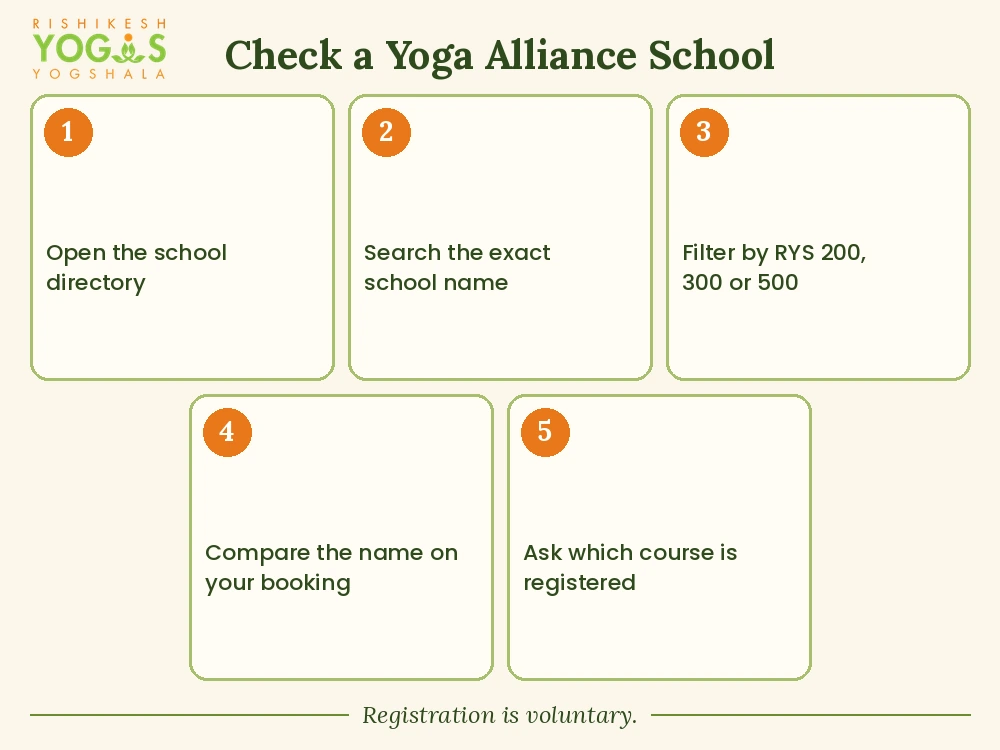
- Open the Yoga Alliance school directory.
- Search the school’s exact name and filter by RYS 200, RYS 300 or RYS 500.
- Compare the listed name with the name on your booking and your certificate.
- Ask the school which course is registered and at which level.
- Keep a copy of the directory page and your confirmation.
This takes only a few minutes and protects you from confusion. If a school’s name is not in the directory, ask them to explain. Some schools use different trading names, so ask which registered name applies to your course.
Is Yoga Alliance certified yoga teacher training necessary?
It depends on your plans. Registration is voluntary, and yoga teaching is not licensed in the way medicine or law is. Some studios and employers ask for an RYT credential, so it can help if you plan to teach abroad or in studios that request it. If you want training for your own practice, the quality of the teachers and syllabus matter more.
Think of registration as one check among several. A registered school can still be a poor fit, and an unregistered school is not automatically poor. Judge the whole picture: the teachers, the syllabus, the daily schedule, the reviews and the written terms, along with the registration. Ask yourself what you need the credential for, and let the answer guide how much weight to give it.
What to check besides registration
A Yoga Alliance certified yoga teacher training is only as good as the teaching behind it.
- The teachers. Who teaches each subject, and what is their experience?
- The syllabus. Does it cover asana, pranayama, meditation, philosophy, anatomy and practice teaching?
- The schedule. Is there enough time for practice and rest? See our daily schedule for an example.
- Class size and support. How much individual attention will you get?
- Reviews. Read independent reviews, not only those on the school’s own site.
- Written terms. Get dates, inclusions and refund terms in writing.
Our 15 questions to ask a yoga school and guide on how to choose a yoga school turn these checks into a simple list.
Why schools register with Yoga Alliance
Yoga Alliance says that becoming a Registered Yoga School lets a school’s graduates register as RYTs and signals that the programme meets its standards. For students, that makes a Yoga Alliance certified yoga teacher training easier to compare: the school has a defined curriculum and has submitted it for review.
The standards describe what a programme must include. Under the current RYS 200 standards, which took effect for newly registered schools on 27 February 2020, the educational categories were condensed from five to four. The core curriculum requires 200 hours of instruction. Schools may add hours to expand on their own focus, so two registered schools can still feel quite different.
Red flags to watch for
- A logo with no school name you can find in the directory.
- Promises of certification in a few days.
- No written syllabus or timetable.
- Pressure to pay quickly with no written terms.
- Teachers whose experience is not described.
Any one of these is a reason to ask more questions. If the answers are vague, look elsewhere.
How to read a registered school’s claims
When a website says Yoga Alliance certified yoga teacher training, check three things: the exact name, the level and the course. A school may be registered at 200 hours but not at 300 hours. A registered course may be a specific programme, not every course the school sells. Ask directly, and keep the answer in writing.
Our course pages and registration
Our course pages for the 100-hour, 200-hour and 300-hour courses list Yoga Alliance under certification. We encourage you to do what we recommend for any school: search the directory, confirm the exact listing and ask us which level applies to the course you want. We are happy to answer questions, so contact us before you book.
Common questions about registered teachers
Does the certificate expire?
The course certificate itself records that you completed training. Yoga Alliance membership is a separate step with its own requirements, which you can read on its site.
Do I need to register after graduating?
No. Registering as an RYT is optional. Many graduates teach without registering, while others register because studios or insurers ask for it.
Can I register if I did an online course?
Ask the school and check Yoga Alliance’s current rules, as they change over time.
Compare levels before you decide
If you are choosing between levels, read our guide to 200-hour vs 300-hour vs 500-hour training, and for the full path see how to become a yoga teacher in India.
Frequently asked questions
Is Yoga Alliance certification necessary?
No. Registration is voluntary and is not a legal licence. It can help if you plan to teach in studios that ask for it.
How do I check if a yoga school is Yoga Alliance registered?
Search the school’s exact name in the Yoga Alliance directory and filter by RYS 200, RYS 300 or RYS 500.
What does RYT 200 mean?
RYT 200 means Registered Yoga Teacher at the 200-hour level. It is for graduates of a 200-hour training at an RYS 200 who register with Yoga Alliance.
Does Yoga Alliance certify yoga teachers?
Yoga Alliance says it does not certify teachers or accredit schools. Its credentialing is a registry. Your school issues the course certificate.
Is a Yoga Alliance certificate valid in India?
Many studios worldwide recognise the credential, but it is not a government licence in India or elsewhere.