Yes, yoga teacher training for personal practice is a real and common reason to enrol: many students join a 200-hour course to deepen their own yoga and never plan to teach. The course gives you structure, daily practice and study that are hard to build alone.
This guide explains what you gain, who it suits and what to weigh before you commit. Course details are on our 200-hour yoga teacher training in Rishikesh page.
Key takeaways
- Yoga teacher training for personal practice is a valid reason to join: you do not have to teach.
- The main gain is depth: a daily routine, correct alignment, breathwork, meditation and philosophy.
- Residential training removes everyday distractions, but the days are long and demanding.
- Decide honestly how much time, energy and travel you can give.
Is yoga teacher training for personal practice worth it?
It is worth it if you want to understand your practice, not only repeat it. A normal class shows you what to do. A teacher training course explains why: how a posture is built, which joints and muscles are working, what the breath is doing and where the practice comes from.
That understanding changes how you practise. You notice small habits, such as collapsing a shoulder or holding the breath in a hard pose, and you know how to correct them. You also stop depending on a teacher to tell you what to do next.
Teaching is only one use of this knowledge. Many graduates return home, keep their own daily practice and never lead a class. The certificate simply records the training. What stays with you is the way you practise.
What you gain for your own practice
This is what our 200-hour course covers, taken from our syllabus.
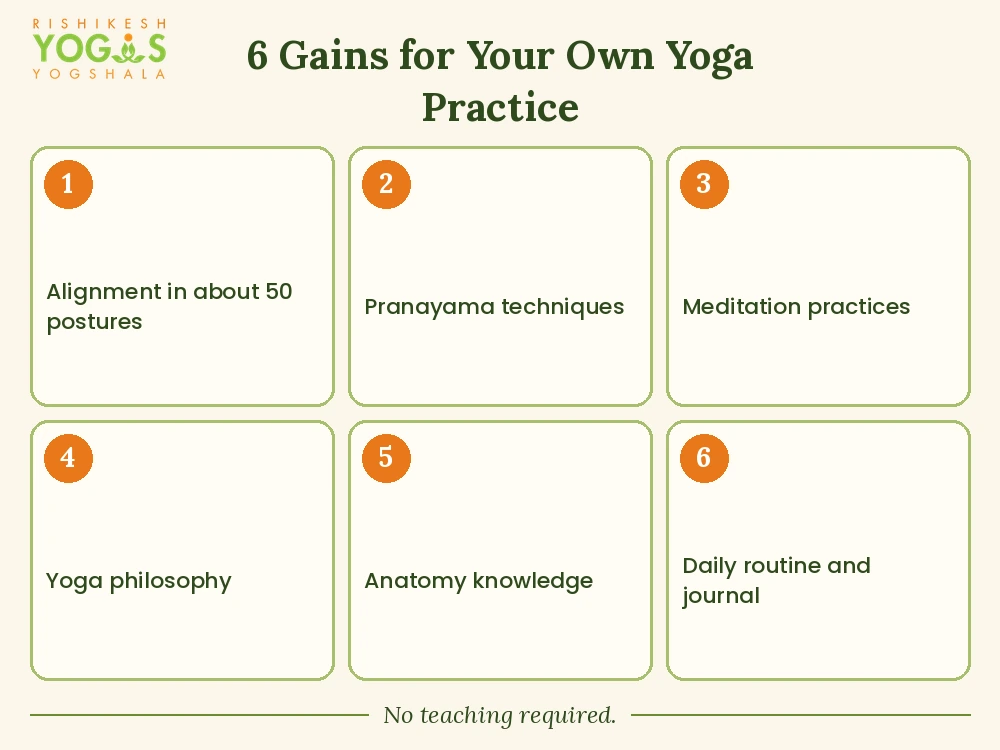
| Area | What the course covers |
|---|---|
| Asana | About 50 postures, with alignment, counter-indications and use of props |
| Pranayama | Ujjayi, Nadi Shodhana, Bhramari, Sheetali and other techniques |
| Meditation | Dharana, yoga nidra, Ajapa Japa, chakra shuddhi and antar mouna |
| Philosophy | The Yoga Sutras of Patanjali, the eight limbs, Advaita Vedanta and the five sheaths |
| Anatomy | Skeletal and muscular systems, planes of movement and flexibility |
A safer, more informed practice
Learning how a posture is built helps you practise more carefully. The National Center for Complementary and Integrative Health describes yoga as generally safe for healthy people when practised appropriately and with a qualified instructor. A course taught by experienced teachers gives you that guidance every day for several weeks.
Breathwork and meditation you can keep
Many people know pranayama and meditation only from short class segments. In teacher training you practise them daily, with time to learn each technique properly. By the end you have a set of tools you can use at home without a class.
Philosophy that explains the practice
The philosophy sessions cover the Yoga Sutras of Patanjali and the eight limbs of yoga. For many students this is the part that changes how they see yoga: it is much more than exercise.
Who yoga teacher training for personal practice suits
- Regular practitioners who feel they have reached a plateau.
- People who want to understand why they do what they do, not only how.
- Anyone who wants a month of focused practice away from daily distractions.
- Students who want to start teaching later, but are not sure yet.
You do not need to be flexible or advanced. Our 200-hour course is for beginner to intermediate students, and flexibility develops with practice.
What daily life is like
Our course is residential and runs for 24 days. Monday to Saturday, the day starts with asana at 6:30 am and ends with lights out at 10 pm. Sunday is free for rest, excursions and local sightseeing. Meals are pure vegetarian, sattvic and prepared in our kitchen.
Alongside practice you attend philosophy talks, alignment and teaching methodology, anatomy and physiology, Hatha yoga, and evening sessions of pranayama, yoga nidra, mantra and meditation. The last session of the day is self-reflection, where students keep a journal. Read the full daily schedule to see how the hours fit together.
How training differs from regular yoga classes
People often ask how yoga teacher training for personal practice differs from simply attending more classes. There are four main differences.
- Depth over variety. You spend days on one posture group, such as standing balances or inversions, and study how each posture works.
- Daily rhythm. Practice, study and rest follow a fixed daily pattern, which builds discipline that casual classes rarely do.
- Time to ask questions. You can ask your teachers about a posture, a breathing technique or a passage of philosophy the same day.
- A community of learners. You train with people who share your interest, which keeps you steady when the days feel long.
A class gives you a sequence to follow. Training gives you the tools to understand and design your own practice, which is the real gain if you do not plan to teach.
What changes in your own practice
Students who join for yoga teacher training for personal practice often describe the same changes, though results differ from person to person. You can expect to leave with:
- a clearer sense of alignment in the poses you already do;
- a daily routine you can repeat at home, including breathwork and a short meditation;
- a vocabulary for what you feel in the body, taken from the anatomy sessions;
- a journal of notes, questions and discoveries from the month;
- the confidence to practise without following a video or class.
The self-reflection hour each evening matters here. Writing down what you noticed each day turns the month from a series of classes into a personal record of progress.
How to prepare if you are not planning to teach
Preparation for yoga teacher training for personal practice is the same as for any student. Practise a few times a week before you arrive so that the early mornings are manageable. Our FAQs suggest reading Light on Yoga by B.K.S. Iyengar and Anatomy of Hatha Yoga by David Coulter, and joining online drop-in classes before you travel. See what to pack for your yoga teacher training for the practical list.
Tell your teachers about any injury or health condition at the start. If you have a health condition, talk to your health care provider before you begin intensive practice.
You will also take part in the teaching practice sessions, even if you never plan to teach. Most students find that explaining a posture to someone else is the quickest way to understand it themselves.
What to weigh before you enrol
Time and energy
The schedule is full. If you cannot be away from work and family for about three and a half weeks, a shorter course may suit you better.
Cost and travel
You need to plan your travel, visa and budget. Our guide to how to apply for yoga teacher training in India explains the booking steps.
Your goals
Ask yourself what you want from the month. If the answer is better practice, more calm and a deeper understanding of yoga, the course fits. If you only want a few relaxing days, a retreat is a better match.
Shorter options if a full course is too much
If you are new to yoga or short on time, compare our 100-hour course with our 7-day and 12-day retreats. The retreats are lighter and have no study or assessment. The 100-hour course is an introduction for beginners.
If you are comparing levels, our guide to 200-hour vs 300-hour vs 500-hour training explains how they connect.
After the course
Yoga teacher training for personal practice does not end at graduation. You may keep the practice only for yourself, or later share it with friends or a small class. Our post on steps after graduating covers both paths. If you are still choosing where to train, start with how to choose a yoga teacher training school or contact us.
Frequently asked questions
Can I do yoga teacher training without wanting to teach?
Yes. Many students join to deepen their own practice. You can use the certificate later or not at all.
Is yoga teacher training worth it for personal practice?
It is worth it if you want structured study in asana, pranayama, meditation and philosophy. It is a demanding commitment, so weigh your time, budget and goals first.
What will I learn in a 200-hour course?
You learn practical Hatha and Vinyasa yoga, pranayama, meditation, yoga philosophy, anatomy and basic teaching skills.
Do I need to be flexible to join?
No. Our course is for beginner to intermediate students. Flexibility develops with regular practice.
Is it better to do a retreat or teacher training for my own growth?
A retreat is shorter and lighter. Teacher training is longer and more structured, with daily study and practice.