
Can beginners join a yoga teacher training? Often yes, but it depends on the school and the course level. A shorter course such as a 100-hour training is the usual first step for newer students, while many schools expect some regular practice before a 200-hour course. At Rishikesh Yogis Yogshala, the best way to know is to tell us your experience and we will suggest the right level.
This guide explains what beginners can expect, how to prepare and which course to consider. You can also see our 100-hour yoga teacher training in Rishikesh and 200-hour yoga teacher training in Rishikesh pages.
Key takeaways
- You do not need to be flexible, strong or advanced to start learning.
- Entry requirements vary, so always ask the school before you book.
- A shorter course is a gentler first step. Our 100-hour course runs for 12 days.
- Teacher training teaches both practice and teaching, step by step.
- Tell your teachers about any injury or health condition.
Can I become a yoga teacher without previous experience?
You can start the path without previous teaching experience, but a good teacher also needs a steady personal practice. A teacher training course is designed to build both: you practise daily, learn the theory and practise teaching with feedback.
The honest answer is that the more regular practice you have before you arrive, the more comfortable the course will feel. If you are completely new, you could begin with classes at home or a short retreat, then join a training when you feel ready. A 3, 5 or 7-day yoga retreat is a way to try daily practice first.
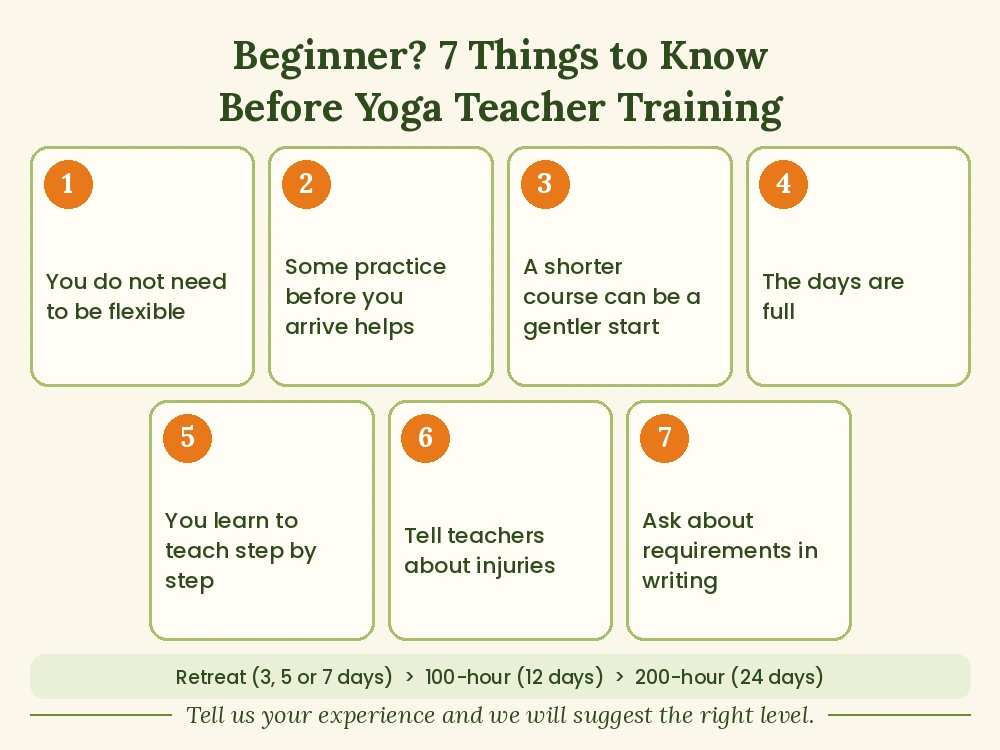
7 things beginners should know
1. You do not need to be flexible
Yoga teacher training is not a flexibility test. Many students begin with stiff hips or shoulders, and teachers show options to make poses suitable for every body. Progress comes from regular practice, not from the first day’s shape.
2. Some practice before you arrive helps
A few weeks or months of regular practice, even at home, makes the early days easier. You will know the names of basic poses, how your body feels and what your breath is doing. This is general advice, not a rule.
3. A shorter course can be a gentler start
Our 100-hour course runs for 12 days, and the 200-hour course for 24 days. If you are new, ask us which suits you. Read more in our guide on how to choose a yoga teacher training in Rishikesh.
4. The days are full
A typical teacher training day has early practice, study, rest and practice teaching. Beginners often find the routine tiring in the first week and then settle in. Timings can change with the weather and season. Students receive the schedule for their course, and timings are tentative.
5. You learn to teach step by step
Nobody expects you to teach a full class on day one. Practice teaching starts with small pieces, and you get feedback each time. Read our post on how practice teaching builds confidence.
6. Tell your teachers about injuries and health conditions
The US National Center for Complementary and Integrative Health (NCCIH) notes that yoga is generally considered safe for healthy people when practised under the guidance of a qualified instructor. If you have an injury, are pregnant or have a medical condition, speak to your doctor first and tell your teacher on arrival. See its page on yoga: effectiveness and safety.
7. Ask about requirements in writing
Before you book, ask the school what experience is needed, what the daily schedule is and what is included. A clear answer in writing is a good sign. You can also look up any school by name in the Yoga Alliance directory. Our post on what’s included in a 200-hour yoga teacher training lists what to ask.
What beginners learn in a teacher training
The course covers asana, pranayama, meditation, yoga philosophy, anatomy basics and teaching methodology. Our 200-hour course ends with a practical teaching assessment and no written exam. Meals are vegetarian and sattvic-inspired, Wi-Fi is available and phones are not used during sessions.
Which course should a beginner choose?
| If you are… | Consider |
|---|---|
| New to yoga and want to try daily practice | A 3, 5 or 7-day retreat |
| Fairly new, want a first teacher training | The 100-hour course |
| Practising regularly and want to learn to teach | The 200-hour course |
This is a guide only. Tell us your experience and we will suggest the right course.
How to prepare before you arrive
- Practise a little each day, even for 15 minutes.
- Learn the names of basic poses and how to breathe through them.
- Pack comfortable, modest clothing for practice and for temples and ghats.
- Read the course schedule and ask about anything unclear.
- Arrive rested. Plan your travel so you are not rushing on the first day.
Ready to start?
If you are not sure which level is right, contact us with your experience and we will help you choose. You can also read about our yoga teacher training course in Rishikesh.
Frequently asked questions
Can beginners join a yoga teacher training? Often yes, depending on the school and the course level. A shorter course is usually a gentler first step. Ask the school about its requirements.
Can I become a yoga teacher without previous experience? You can start learning without teaching experience, but a teacher also needs a steady personal practice. A teacher training builds both.
Do I need to be flexible? No. Teachers show options for every body, and flexibility grows with practice.
Which course is best for a beginner? Our 100-hour course runs for 12 days and can be a gentler start. Ask us which suits your experience.
Is there a written exam? No written exam in our 200-hour course. It ends with a practical teaching assessment.
What if I have an injury? Speak to your doctor first and tell your teacher on arrival, so that practice can be adapted safely.