
How to choose a yoga teacher training in Rishikesh comes down to ten checks: the course length that fits your goal, the school’s registration, who teaches you, the daily schedule, the group size, the food and rooms, the way you are assessed, the real cost, honest reviews and how the school answers your questions. Rishikesh has many schools, so a clear checklist saves time and money.
This guide walks through each check in plain steps. If you already know the level you want, see our yoga teacher training course in Rishikesh page.
Key takeaways
- Choose the level first: 100, 200 or 300 hours.
- Check a school’s registration yourself in the Yoga Alliance directory.
- Ask who will teach you, and what their training is.
- Compare what is included, what costs extra and the booking terms, in writing.
- Be careful with guarantees, unclear teachers and very low prices.
What does a yoga teacher training involve?
A yoga teacher training is a structured course that teaches you to practise and teach yoga. It usually includes asana, pranayama, meditation, yoga philosophy, anatomy basics and teaching methodology. Rishikesh sits on the River Ganga in the Himalayan foothills and is widely known as a centre for yoga; Wikipedia’s Rishikesh entry describes its long pilgrimage history. That tradition is why so many students come here, and why choosing carefully matters.
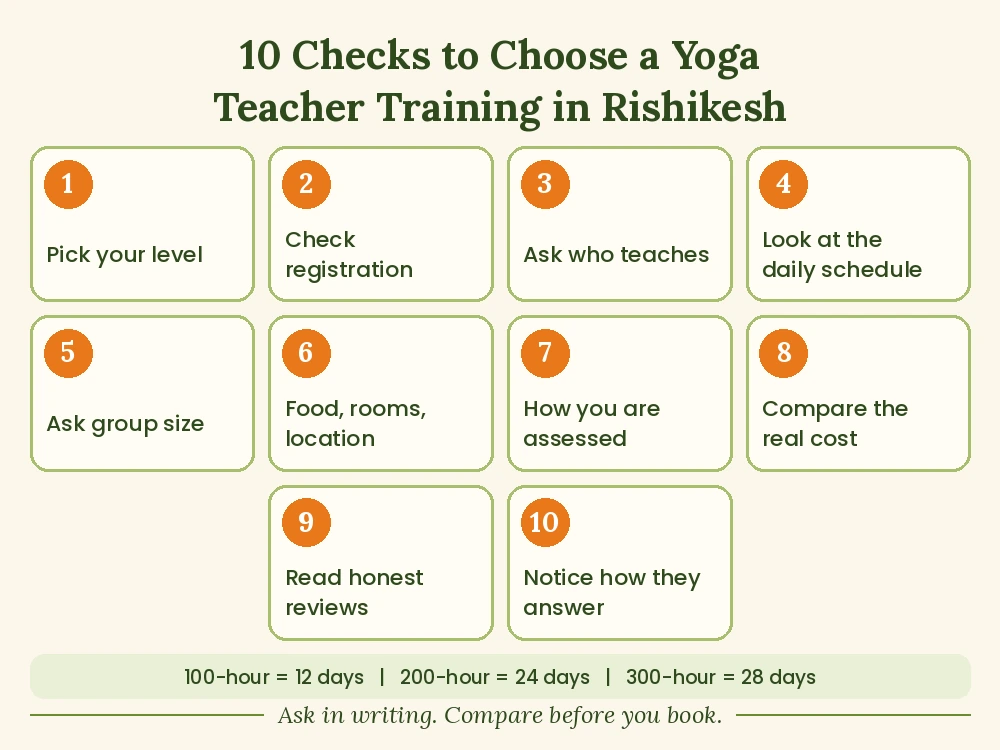
10 tips to choose a yoga teacher training in Rishikesh
1. Pick the level that fits your goal
Your first decision is the course length. Our school offers three levels:
| Course | Length | Suits |
|---|---|---|
| 100-hour | 12 days | A shorter first step, or a deeper practice |
| 200-hour | 24 days | The standard first level for learning to teach |
| 300-hour | 28 days | Teachers who want to go further |
A 300-hour course generally builds on a 200-hour training, so check what the school expects. Read more in our post on what’s included in a 200-hour yoga teacher training.
2. Check the school’s registration yourself
Many schools say they are Yoga Alliance registered. Do not rely on the website alone. Yoga Alliance keeps a public directory where you can search for a school by name. Look for the registered school (RYS) level that matches the course you want. Rishikesh Yogis Yogshala is registered as an RYS 200 and RYS 300 school.
3. Ask who will teach you
A course is only as good as its teachers. Ask for names, training and how long each has taught. Look for a teacher who can explain their own background clearly. Our founder, Uttam Ghosh, began learning yoga before 2009, received Kundalini initiation in 2009, holds Bachelor’s and Master’s degrees in Yoga and is listed with Yoga Alliance as E-RYT 500. Our team also includes Deepak (Vinyasa Flow), Ram (mantra chanting), Shivam (yoga) and Anil (yoga and anatomy).
4. Look at the daily schedule
Ask for a sample timetable. A balanced day has asana, pranayama, meditation, study, practice teaching and rest. Be wary of a schedule with no rest or very little teaching practice. Timings can change with the weather and season, so ask how changes are handled.
5. Ask about group size
Smaller groups mean more attention. Ask for the maximum batch size and the number of teachers present in each class. Our 200-hour course has a maximum of 15 students.
6. Check food, rooms and location
You will spend most of your day in the same place. Ask about room types, bathrooms, Wi-Fi and the meals. Our meals are vegetarian and sattvic-inspired, and Wi-Fi is available. A non-residential option exists for students who arrange their own stay. Students enrol in the core course and arrange their own accommodation, and a reduced fee applies when accommodation and meals are excluded.
7. Understand how you are assessed
Some schools use written exams, some use practical tests, some use both. Our 200-hour course ends with a practical teaching assessment and no written exam. Read more in our post on how practice teaching builds confidence.
8. Compare the real cost
A low headline fee can hide extras. Ask what is included in the fee, what you pay on arrival and what the booking and refund terms are. Always check the school’s own fees page for current information rather than third-party listings. See our fees and schedule page.
9. Read honest reviews
Look at recent reviews on independent sites and ask the school to connect you with past students. Be careful with reviews that all sound alike.
10. Notice how the school answers you
A good school replies clearly, shares details in writing and does not pressure you to pay quickly. Ask your questions by email, and see whether the answers are specific.
Residential, non-residential or online?
Most students come to Rishikesh to live and train on site. If you prefer to stay elsewhere, ask about the non-residential option. If travel is not possible, we also offer an online 200-hour yoga teacher training. Ask what is live, what is recorded and how you are assessed.
Is a retreat better than a teacher training?
If you want to experience daily yoga without a teaching goal, a 3, 5 or 7-day yoga retreat may suit you better. See our post on yoga teacher training vs a retreat.
Red flags to watch for
- No named teachers or no teacher backgrounds
- Promises that you will get a job or a certain income
- Registration that cannot be found in the directory
- A very low price with no details of what is included
- Pressure to pay a large amount straight away
- No written schedule or refund terms
Is yoga teacher training safe?
The US National Center for Complementary and Integrative Health (NCCIH) notes that yoga is generally considered safe for healthy people when practised under the guidance of a qualified instructor. See its page on yoga: effectiveness and safety. If you have an injury or health condition, speak to your doctor first and tell the school before you arrive.
Ready to choose?
If this checklist matches what you are looking for, explore our 200-hour yoga teacher training in Rishikesh or contact us with your questions. We are happy to answer every question on this list.
Frequently asked questions
How do I choose a yoga teacher training in Rishikesh? Choose the level first, check the school’s registration in the Yoga Alliance directory, ask about teachers, schedule, group size, food and rooms, and compare what is included and what costs extra.
Which course is best for a beginner? A shorter course such as the 100-hour training can be a gentler start. Ask the school which level suits you.
How long are the courses? At our school, the 100-hour course runs for 12 days, the 200-hour course for 24 days and the 300-hour course for 28 days. See the Fees and Schedule page for current dates.
How do I check if a school is registered with Yoga Alliance? Search for the school by name in the Yoga Alliance directory and check the registered school level.
Can I do a yoga teacher training online? Some schools offer online courses, including ours for the 200-hour level. Ask what is live, what is recorded and how you are assessed.
Is a certificate enough to get a teaching job? No. A certificate gives you a base, but jobs depend on your skills, experience and local requirements.