
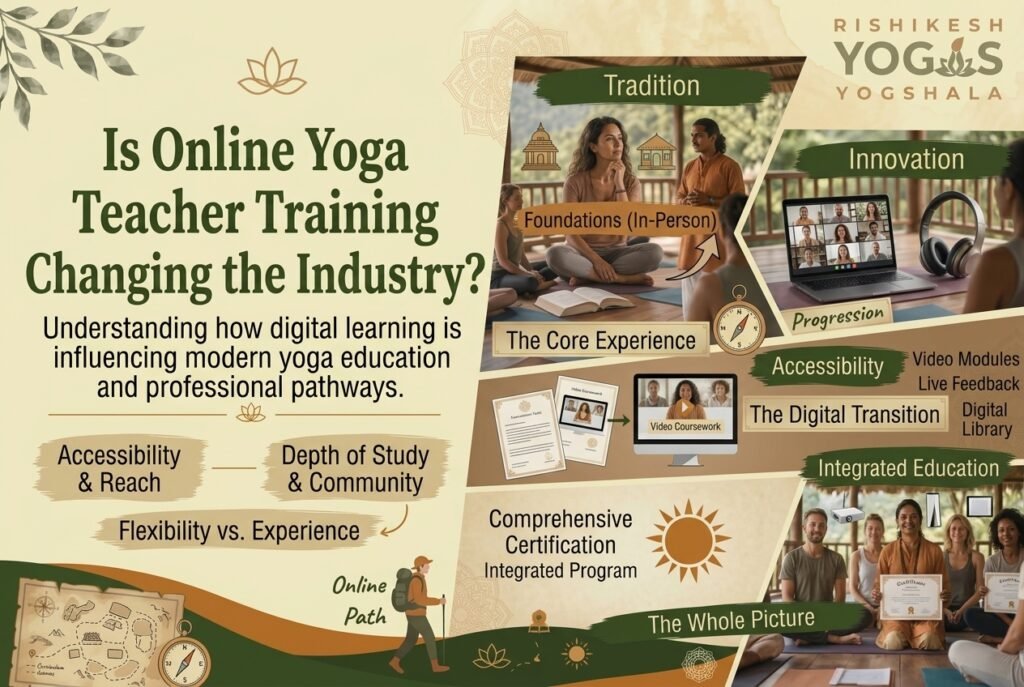
A decade ago, the idea of a fully remote Yoga Teacher Training would have struck most people in the industry as a contradiction in terms — how do you teach hands-on adjustment, physical alignment correction, and immersive practice through a screen? Today, online YTT is a genuinely mainstream option, accepted by Yoga Alliance and offered by established schools alongside their in-person programs. It’s worth understanding what actually drove this shift and what it means going forward.
What Accelerated Online YTT’s Acceptance
Global events in the early 2020s forced the entire wellness education industry to adapt quickly to remote formats, and yoga teacher training was no exception. What started as a temporary necessity for many schools proved durable once students and accrediting bodies alike saw that structured, well-designed online programs could genuinely deliver the core educational content of a 200-Hour certification.
How Online YTT Has Matured as a Format
Early online programs were often criticized, fairly, for being little more than pre-recorded lecture content with minimal interaction or feedback. Established programs today generally include live sessions, practicum feedback through video submission, and structured community interaction — a considerably more developed format than the early, rougher versions of remote training.
What Online Training Still Can’t Fully Replicate
Hands-on physical adjustment remains the clearest gap between online and in-person training — a teacher physically correcting your alignment is genuinely difficult to replace through video instruction alone, however well-designed the program. This is part of why most established schools continue to offer in-person training as their primary or flagship program, treating online as a genuine alternative rather than a full replacement.
Is This Trend Reshaping Who Becomes a Teacher?
Online YTT has genuinely expanded access to certification for people who couldn’t previously commit to a month away from work, family, or other responsibilities — parents, full-time employees, and people managing health conditions that make extended travel difficult. This is arguably the most significant industry-wide impact: not replacing in-person training, but expanding who’s able to pursue certification at all.
What This Means for the Job Market
As online-certified teachers enter the workforce alongside in-person-trained teachers, most studios and employers have adapted to evaluate teaching quality directly — through interviews, trial classes, and demonstrated skill — rather than strictly filtering by training format. The certificate itself, from either format, generally carries similar formal weight; what varies more is the individual teacher’s actual readiness and skill, which employers increasingly assess directly rather than assuming based on format alone.
Where This Trend Likely Goes Next
It’s reasonable to expect continued refinement of online formats — more sophisticated feedback tools, deeper live interaction, possibly hybrid models combining remote study with a shorter in-person intensive component. Rather than online replacing in-person training, the more likely trajectory is both formats continuing to coexist and serve genuinely different student needs, much as they do today.
How Schools Have Adapted Their Online Offerings
Established schools that added online programs alongside their in-person offerings have generally learned, through direct student feedback, which elements translate well to remote formats and which don’t. Theory, philosophy, and anatomy lectures tend to translate very well online, sometimes even benefiting from the ability to pause and revisit material. Practical alignment feedback has proven harder to replicate, which is why many stronger online programs now build in detailed video submission and review processes to partially bridge that gap.
What This Means for Someone Choosing Between the Two
If you’re deciding between formats yourself, it’s worth thinking honestly about which gap matters more to you — the convenience and accessibility of studying from home, or the hands-on correction and full immersion of training in person. Neither choice is inherently wrong, and this industry shift toward genuine acceptance of both formats means you’re no longer choosing between a “real” certification and a lesser alternative — both are legitimate, Yoga Alliance recognized paths, suited to different circumstances and priorities.
Some students also use online training as a stepping stone — completing a 200-Hour certification remotely to confirm teaching is genuinely the right direction for them, before committing to the larger investment of in-person travel for more advanced training later. This layered approach has become considerably more common as online options have matured and gained wider acceptance across the industry.
Whichever path draws you, the fact that this is even a genuine, respected choice today — rather than online being dismissed outright as a lesser shortcut — is itself the real story of how much the industry has shifted over a relatively short period of time.
If you’re weighing this decision yourself and want to talk through which format genuinely fits your circumstances, we offer both in-person and online 200-Hour programs and are happy to help you think through which makes more sense for where you are right now.
There’s no wrong answer here — only the format that actually fits your life circumstances today, which is exactly the kind of practical question we’d rather help you work through honestly than push you toward one option over the other.
FAQs
Is a certificate from online Yoga Teacher Training viewed differently by employers?
Generally not on paper — most studios evaluate teaching quality directly through interviews and trial classes rather than filtering candidates by training format alone.
What’s the biggest limitation of online Yoga Teacher Training?
Hands-on physical adjustment and correction is the clearest gap — something genuinely difficult to fully replicate through remote instruction, however well-designed the program.
Will online training eventually replace in-person Yoga Teacher Training?
This seems unlikely — the more probable trajectory is both formats continuing to coexist, serving different student needs and circumstances rather than one fully displacing the other.