
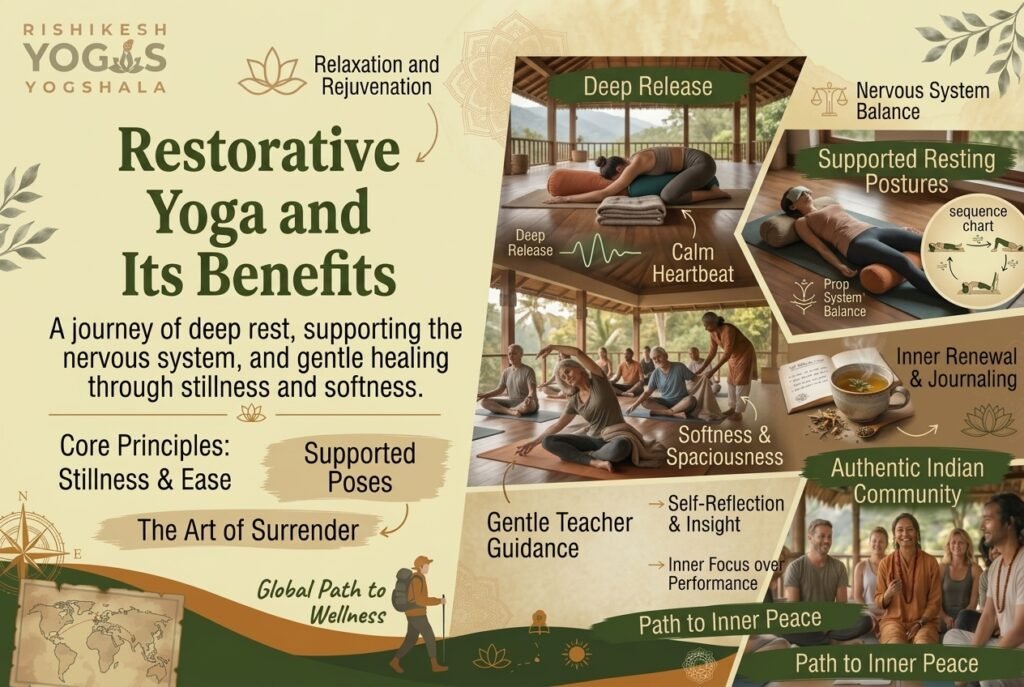
“What is restorative yoga?” comes up often from students who’ve heard the term used alongside Yin yoga and assumed they’re the same thing — they’re related but genuinely distinct, and restorative yoga specifically deserves its own explanation, since it’s grown significantly in popularity as a standalone practice.
What Restorative Yoga Actually Is
Restorative yoga uses props — bolsters, blankets, blocks — to fully support the body in gentle, passive poses held for extended periods, often five to twenty minutes each. Unlike most yoga styles, there’s minimal to no active muscular engagement; the body is entirely supported by props, allowing complete physical release rather than any form of exertion or stretching effort.
How It Differs From Yin Yoga
Restorative and Yin yoga are often confused, but they have different goals. Yin yoga applies gentle sustained stress to connective tissue, aiming to increase flexibility over time through mild discomfort held with awareness. Restorative yoga aims for the opposite — complete comfort and full physical support, with no stretching sensation intended at all. If Yin is about gently working at your edge, restorative is about not having an edge to work at all.
The Physiological Benefits
Restorative yoga is specifically designed to activate the parasympathetic nervous system — the body’s rest-and-digest state — counteracting the sympathetic, fight-or-flight activation that chronic stress keeps many people locked into. Extended time in fully supported, comfortable positions allows the nervous system to genuinely downshift in a way that’s difficult to access through more active practice styles.
Who Benefits Most From Restorative Practice
- People dealing with high stress or burnout, where the nervous system genuinely needs downregulation, not more physical exertion.
- Those recovering from injury or illness, where more active styles aren’t appropriate but complete stillness isn’t either.
- Students with chronic pain conditions, who often find fully supported positions provide relief that active stretching doesn’t.
- Anyone whose regular practice is dominated by intense, active styles and would benefit from genuine balance in the opposite direction.
What a Restorative Class Actually Involves
A typical restorative class might include only four to six poses across a full session, each held for an extended period with careful prop setup beforehand. The pace is deliberately unhurried — setup itself is part of the practice, not a rushed preamble to the “real” work. For students used to a physically active class, the stillness can initially feel unfamiliar, even uncomfortable in its own way, before the benefit becomes clear.
Restorative Yoga’s Place in a Broader Practice
Restorative yoga works well as a complement to more active styles rather than a replacement for them — many practitioners and teachers use it specifically to balance out weeks dominated by Vinyasa or Ashtanga practice, or during periods of particularly high life stress. For teacher trainees, understanding restorative practice adds a genuinely useful tool for supporting students who need something your more active classes simply can’t offer them.
How to Set Up a Restorative Pose Properly
Proper prop setup is genuinely central to restorative practice — a poorly supported pose defeats the purpose entirely, since any residual muscular effort to maintain position undermines the full release the practice is built around. This is part of why restorative yoga, despite looking simple from the outside, benefits significantly from qualified instruction, at least initially, to learn proper setup before practicing independently.
Restorative Yoga as Part of Teacher Training
Some Yoga Teacher Training programs include restorative yoga as a dedicated module, recognizing it as a genuinely distinct skill set from more active teaching — proper prop setup, verbal cueing for a completely different pace, and creating the right atmosphere for a class built around stillness rather than movement. If restorative or therapeutic yoga is an area you’re specifically interested in developing as a teacher, it’s worth asking a prospective school whether and how deeply this is covered in their curriculum.
Even for teachers who don’t plan to specialize in restorative yoga specifically, having some grounding in its principles is genuinely useful — the ability to offer a fully supported, restful pose to a student who’s struggling, injured, or overwhelmed during a regular class is a valuable tool that complements a broader teaching skill set.
If you’ve only ever experienced more active styles of yoga, it’s worth trying a genuine restorative class at least once — the stillness can feel unfamiliar at first, but most students who give it a real chance come away with a noticeably different appreciation for what a fully supported, unhurried practice can offer.
As with many aspects of yoga, restorative practice tends to make far more sense once experienced directly than when only read about — if the description here has piqued your curiosity, seeking out an actual class is the natural next step.
We’re glad to answer any questions about how restorative principles are woven into our own teaching, whether or not it ends up being an area you choose to specialize in yourself.
FAQs
Is restorative yoga the same as Yin yoga?
No, though they’re related — Yin applies gentle sustained stretch to connective tissue, while restorative yoga aims for full physical support and comfort with no stretching sensation at all.
How long are poses held in restorative yoga?
Typically five to twenty minutes per pose, considerably longer than most active yoga styles, since the body is fully supported by props rather than actively engaged.
Is restorative yoga a good practice for beginners?
Yes — its gentle, fully supported nature makes it accessible to virtually any fitness level or physical condition, unlike more physically demanding styles.