
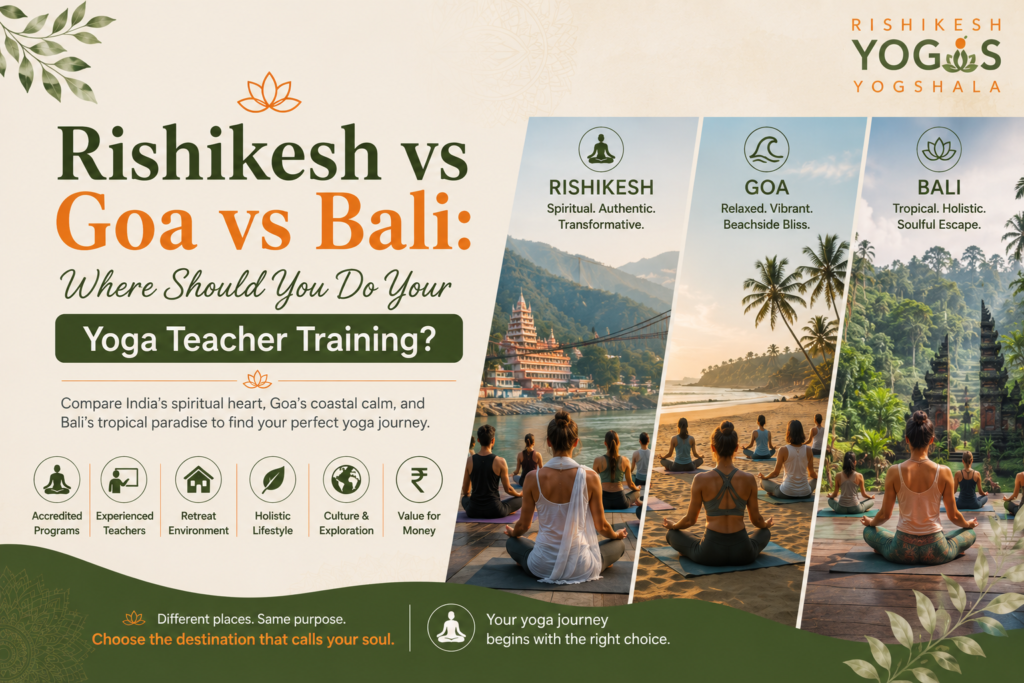
Rishikesh, Goa, and Bali are the three destinations that come up most often when people start researching Yoga Teacher Training abroad. Each has genuine strengths — the right choice depends on what you’re actually looking for beyond the certificate itself, and the differences run deeper than climate and scenery.
Rishikesh: The Traditional Root
Rishikesh is where much of modern yoga’s philosophy and teaching lineage actually originates, and it shows in how training here is structured — heavier emphasis on philosophy, meditation, and traditional method alongside asana practice. It sits on the Ganga in the Himalayan foothills, and the town itself is built around yoga and spiritual practice rather than tourism first, which shapes the entire atmosphere of a training course here.
Because Rishikesh has been a center of yogic study for so long, the density of experienced, traditionally trained teachers is genuinely higher here than almost anywhere else in the world. Ashrams, temples, and the daily rhythm of the town all reinforce the same practice you’re there to study — it’s difficult to separate the training from the environment it happens in.
Goa: The Beach Alternative
Goa offers a more relaxed, beach-adjacent training experience, often appealing to students who want yoga training combined with a beach holiday atmosphere. Training quality varies significantly between schools, and the environment leans more toward leisure tourism than spiritual immersion.
This isn’t necessarily a drawback — some students specifically want a lighter, more relaxed pace to their training, and Goa’s atmosphere suits that. But it does mean doing more careful research into any specific school’s credentials, since the concentration of long-established, deeply traditional schools is lower there than in Rishikesh.
Bali: The International Wellness Hub
Bali has become a major wellness tourism destination, with a large number of international teachers and a polished, resort-style training experience. It’s often more expensive than Rishikesh or Goa, and the yoga culture there is largely imported rather than rooted in a centuries-old local tradition.
Bali excels at a certain kind of experience — beautiful facilities, strong social media presence, an international community of practitioners. What it doesn’t offer is the same depth of connection to yoga’s traditional roots that a location like Rishikesh provides simply by being where that tradition actually developed.
Comparing Cost and Value
Rishikesh is generally the most affordable of the three for a comparable quality of training, once you factor in both course fees and daily living costs. Bali tends to command premium pricing due to its resort-style positioning, while Goa sits somewhere in between, with wide variation depending on the specific school.
What About Climate and Timing?
Rishikesh has distinct seasons, with the most popular training months generally falling outside the peak monsoon period. Goa and Bali both have more consistently warm, humid climates year-round, which some students prefer, though it comes with its own trade-offs in terms of comfort during intensive physical practice.
Which Should You Choose?
If you want your certification to come with genuine depth in yoga philosophy and traditional method — not just the physical practice — Rishikesh is the strongest choice, and it’s generally more affordable than Bali for a comparable quality of training. If your priority is a beach environment and a more relaxed pace, Goa or Bali may suit you better, though it’s worth researching the specific school carefully rather than the destination alone, since training quality varies a lot within each location.
Whichever destination you’re drawn to, the single most important research step is the same everywhere: verify the school’s Yoga Alliance accreditation directly, read genuine student reviews, and ask specifically who will be teaching you — destination reputation alone doesn’t guarantee any individual school is a good fit.
Visa and Travel Logistics Across Destinations
Practical travel logistics differ meaningfully between the three. India generally offers accessible e-Visa options for many nationalities, well-suited to a few weeks of training. Indonesia (for Bali) and its own visa system operate differently, with their own eligibility rules and durations. Whichever destination you’re considering, factor visa research into your decision early, rather than assuming logistics will simply work themselves out once you’ve already chosen a school.
Flight accessibility also varies — Rishikesh requires a connection through Delhi, adding a short domestic flight or a scenic road journey through the hills, while Bali and Goa both have more direct international flight options into their respective regional airports. Neither is a dealbreaker, but it’s worth building into your total travel time and budget.
Language and Cultural Immersion
Rishikesh training is typically conducted in English but set within a genuinely Indian cultural and religious environment — temple sounds, local customs, and a town whose daily rhythm is shaped by Hindu spiritual practice. Bali offers its own distinct cultural backdrop, Balinese Hindu tradition layered with a large, established international expatriate community. Goa carries a different cultural identity again, shaped by its Portuguese colonial history alongside Indian coastal culture. Each offers genuine cultural immersion, just of quite different character.
FAQs
Is Rishikesh more affordable than Bali for Yoga Teacher Training?
Generally yes — Bali’s positioning as an international wellness resort destination tends to come with higher accommodation and course costs compared to Rishikesh.
Does the destination affect the value of my Yoga Alliance certification?
No — Yoga Alliance certification is recognized internationally regardless of where you trained, as long as the school itself is accredited.
Which destination is best for learning yoga philosophy in depth, not just the physical practice?
Rishikesh is generally considered the strongest choice for this, given its role as a historical center of yoga philosophy and traditional teaching.