
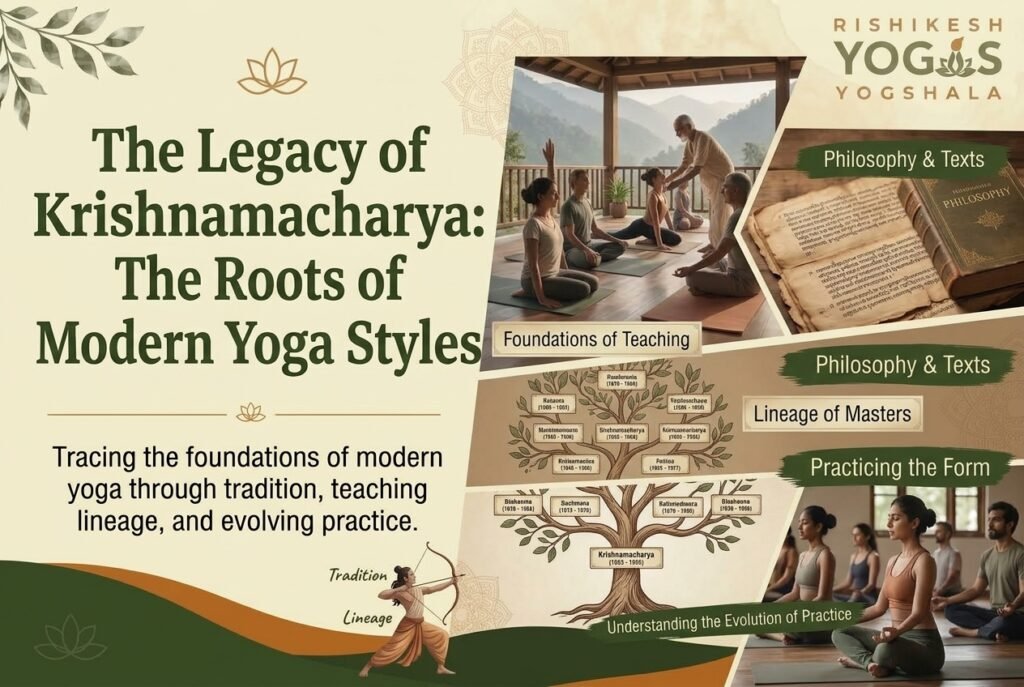
If you’ve studied Ashtanga, Vinyasa, or Iyengar yoga, you’ve studied a lineage that traces back, directly or indirectly, to one teacher: Tirumalai Krishnamacharya. Understanding his legacy gives real depth to your own practice and teaching, well beyond just performing the poses these styles are known for.
Who Was Krishnamacharya?
Krishnamacharya, widely referred to as “the father of modern yoga,” was a 20th-century Indian yoga teacher whose approach to asana practice and teaching methodology shaped nearly every major style of yoga practiced internationally today. He taught at the Mysore Palace in South India, where he developed and refined the dynamic, structured approach to asana that would go on to influence generations of students and, through them, millions of practitioners worldwide.
The Students Who Carried His Teaching Forward
Several of Krishnamacharya’s direct students went on to found or shape what are now among the most widely practiced yoga styles internationally. Pattabhi Jois, one of his students, developed Ashtanga Yoga, the structured, sequence-based practice known for its physically demanding, fixed series of postures. B.K.S. Iyengar, another student, developed Iyengar Yoga, known for its precise attention to alignment and use of props. Krishnamacharya’s own son, T.K.V. Desikachar, continued to develop and teach his father’s broader, more individualized approach to yoga therapy and practice.
How This Lineage Connects to Vinyasa
Vinyasa yoga, the breath-linked flowing style taught widely in studios today, draws heavily on the dynamic, sequenced approach to asana that Krishnamacharya developed and that Pattabhi Jois formalized further through Ashtanga. Understanding this connection helps explain why Ashtanga and Vinyasa share so much structural DNA, even though they’re taught quite differently today.
Why This History Matters for Teacher Trainees
Knowing where these styles actually come from adds genuine depth to how you teach them, beyond simply cueing poses correctly. It also helps you explain to your own future students why certain styles emphasize certain things — Ashtanga’s rigid sequencing, Iyengar’s precision with props, Vinyasa’s breath-led flow — as living continuations of a specific teaching lineage, not arbitrary stylistic choices.
Krishnamacharya’s Broader Teaching Philosophy
Beyond the specific styles that emerged from his teaching, Krishnamacharya is also known for a broader, influential principle: that yoga should be adapted to the individual, not the individual forced into a single fixed method. This idea — that the same underlying practice can and should be taught differently depending on the student’s body, age, and needs — remains genuinely influential in how thoughtful modern yoga teachers approach their own students, well beyond any single style.
Carrying This Forward in Your Own Teaching
Understanding this lineage isn’t just historical trivia — it’s part of what separates a teacher who can competently instruct a sequence from one who genuinely understands the tradition they’re teaching within. This kind of grounding in yoga’s actual history and philosophy is exactly the depth we aim to build into our 200-Hour Yoga Teacher Training, alongside the physical and technical skills.
How Krishnamacharya’s Approach Differed From What Came Before
Prior to Krishnamacharya’s era, asana practice within the broader yogic tradition was often a smaller, less emphasized component compared to meditation, philosophy, and other spiritual disciplines. Krishnamacharya’s contribution was, in significant part, developing and systematizing a more dynamic, physically structured approach to asana specifically — which is part of why so much of what’s recognized globally as “yoga” today, with its strong emphasis on physical postures, traces back so directly to his teaching and that of his students.
Why His Teaching Spread So Widely
Krishnamacharya’s direct students went on to teach internationally, carrying his methodology to Europe, the United States, and beyond, which is a significant part of why his influence became so foundational to how yoga developed as a global practice rather than remaining confined to India. Pattabhi Jois’s Ashtanga teaching in particular drew large numbers of international students to Mysore over subsequent decades, further spreading this lineage of practice worldwide.
Studying This History as Part of Your Own Training
For teacher trainees, studying this lineage isn’t just an interesting historical footnote — it’s part of developing genuine expertise and authority as a teacher, the kind of depth that comes through in how you explain and contextualize your teaching to your own future students, not just in how well you demonstrate a pose yourself.
A teacher who can explain why a particular sequence or breathing method exists, rooted in a genuine historical and philosophical tradition, offers students something meaningfully different from a teacher who can only demonstrate the movements themselves. This kind of grounding is part of what separates a good teacher training from a purely physical one.
This history also offers a useful reminder for any teacher: the styles we practice and teach today are living continuations of a specific lineage, shaped by real people with real teaching philosophies — not fixed, timeless forms handed down unchanged, but a tradition that continues to be shaped by every generation of teachers who carry it forward, including the students training with us today.
FAQs
Did Krishnamacharya create Ashtanga yoga himself?
Ashtanga Yoga as it’s known today was developed by his student, Pattabhi Jois, building on Krishnamacharya’s dynamic approach to asana practice and sequencing.
What styles of yoga trace back to Krishnamacharya’s teaching?
Ashtanga, Iyengar, and much of what’s taught as Vinyasa yoga today all trace back, directly or through his students, to Krishnamacharya’s teaching and methodology.
Why is understanding this history useful for a yoga teacher?
Knowing the lineage behind the style you teach adds depth to your understanding and helps you explain to students why a style emphasizes what it does, rather than teaching poses as arbitrary instructions.