
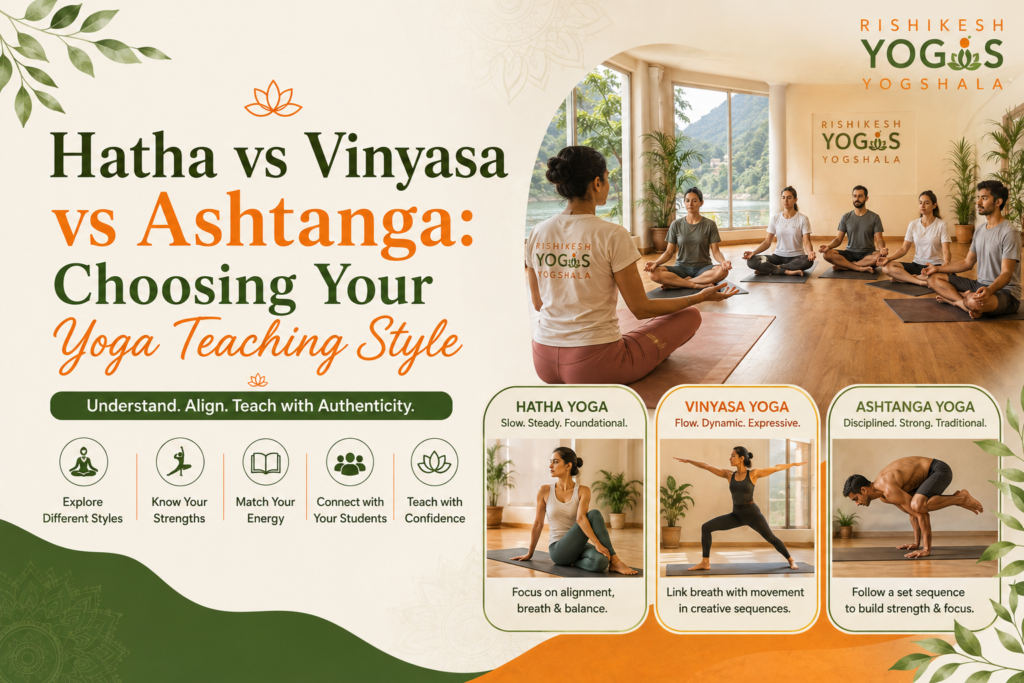
“What’s the difference between Hatha and Vinyasa yoga?” is one of the most common questions we hear from prospective students, usually followed closely by “and where does Ashtanga fit in?” It’s a fair question — all three get grouped together as “traditional yoga,” but they teach very differently, and choosing between Hatha vs Vinyasa vs Ashtanga shapes what kind of classes you’ll be equipped to teach once you’re certified.
Before choosing a Yoga Teacher Training, it helps to actually understand what separates these three styles. Picking a style isn’t just about what feels good to practice; it’s about which one prepares you to teach the kind of classes you actually want to lead.
Hatha Yoga: The Slower, Foundational Style
Hatha is the foundation most other styles are built on. Poses are held longer, the pace is slower, and the focus is on precise alignment, breath control, and building a stable base of physical and mental awareness. For teacher trainees, Hatha is often where you develop the clearest understanding of anatomy and alignment — knowledge that carries into every other style you might teach later.
Because the pace is slower, Hatha also gives new students more room to actually think about what they’re doing in a pose, rather than reacting quickly to keep up with a flow. This makes it a particularly strong starting point if you’re new to yoga altogether, since the fundamentals get more space to actually settle in before you add speed or complexity on top of them.
Vinyasa Yoga: The Dynamic, Flow-Based Style
Vinyasa links breath to movement in a continuous flow, moving from pose to pose rather than holding each one. It’s more dynamic and physically demanding than Hatha, and tends to suit students who want to teach flow-based classes — the style most Western studios associate with a typical “yoga class.”
Teaching Vinyasa well requires a different skill set than teaching Hatha — you’re cueing movement in real time, keeping a class moving as one breath, one movement, which demands strong command of sequencing and pacing. Many teacher trainees find Vinyasa the most challenging style to teach confidently at first, precisely because there’s less room to pause and think mid-class.
Ashtanga Yoga: The Structured, Rigorous Style
Ashtanga follows a fixed sequence of postures performed in the same order every time, synchronized with a specific breathing method (ujjayi breath) and internal locks (bandhas). It’s the most physically rigorous of the three and the most structured — useful for teachers who want deep mastery of one specific method rather than flexibility across styles.
Because the sequence never changes, Ashtanga rewards students who like repetition as a teaching tool — you’re not improvising a new class plan each session, you’re deepening your understanding of the same sequence over and over. Some teachers find this liberating; others find it limiting compared to the creative freedom Vinyasa offers.
Hatha vs Vinyasa: Which Is Better for Beginners?
This is the single most-asked version of the comparison, so it deserves a direct answer: Hatha is generally considered better for beginners. The slower pace gives you time to learn correct alignment before adding speed, and it’s gentler on the body while you’re still building strength and flexibility. Vinyasa is not usually recommended as a true first style, though many studios do offer beginner-friendly Vinyasa classes with a slower pace than a standard flow.
How These Styles Actually Differ in the Body
Hatha tends to build stability and strength through longer holds, which is gentler on the cardiovascular system but demanding on muscular endurance. Vinyasa raises heart rate more consistently throughout a class, closer to a moving workout. Ashtanga combines both — sustained holds within a physically demanding, sweat-inducing sequence — which is part of why it’s often considered the most physically intense of the three.
Which Should You Train In?
If you’re new to yoga entirely, Hatha gives you the strongest foundation to build on. If you’re drawn to teaching dynamic, flow-based classes, Vinyasa is the more natural fit. If you want deep technical mastery of a single, disciplined method, Ashtanga rewards that focus.
Many 200-Hour Yoga Teacher Training programs — including ours — don’t force a single choice. Training in Hatha and Vinyasa together gives you both a strong foundation and the flexibility to teach the kind of classes that are actually in demand at most studios, since very few working yoga teachers only ever teach one style throughout their career.
It’s also worth asking any prospective school directly which styles their 200-Hour curriculum actually covers in depth, since “traditional yoga” as a marketing phrase can mean quite different things depending on the school.
Common Misconceptions About These Styles
A common misconception is that Hatha is “easier” than Vinyasa or Ashtanga simply because the pace is slower — in practice, holding a pose correctly for an extended period is often more physically demanding than moving through it quickly, since there’s nowhere to hide poor alignment or engagement. Slower doesn’t mean less rigorous, it means a different kind of rigor.
Another common assumption is that Ashtanga and Vinyasa are essentially the same style with different names. While Vinyasa often borrows structural elements from Ashtanga, the fixed sequence and specific breath-and-bandha method of Ashtanga make it a distinct, more rigidly defined practice, whereas Vinyasa allows far more variation and creative sequencing from teacher to teacher.
How This Choice Affects Your Career as a Teacher
The style you train most deeply in shapes the kind of studio roles you’ll be best positioned for early in your teaching career. Studios running primarily flow-based group classes will look for strong Vinyasa teaching skills; more traditional or therapeutic-focused studios may value Hatha expertise more highly; specialized Ashtanga studios or Mysore-style programs will specifically want teachers trained deeply in that method.
This doesn’t mean you’re locked into one path forever — many teachers expand into additional styles over years of practice and further training. But it does mean it’s worth thinking honestly about what kind of classes you actually want to teach, not just which style felt most enjoyable to practice yourself during your training.
It’s also worth remembering that the best teachers, regardless of style, tend to share certain qualities beyond their chosen practice — clear communication, genuine attentiveness to their students, and a solid grounding in anatomy and safety. Style is an important starting point for your training, but it’s not the only thing that will determine what kind of teacher you become.
FAQs
Do I need to already know a specific style before enrolling in a 200-Hour YTT?
No — 200-Hour programs are designed to teach these styles from the ground up, including for complete beginners.
Can I learn more than one style in a single teacher training?
Yes. Programs that combine Hatha and Vinyasa, for example, let you build a strong foundation while also developing the flow-based teaching skills most studios look for.
Is Hatha or Vinyasa better for beginners?
Hatha is generally considered the better starting point — the slower pace makes it easier to focus on correct alignment before adding speed or complexity, which lowers injury risk while you’re still building strength.