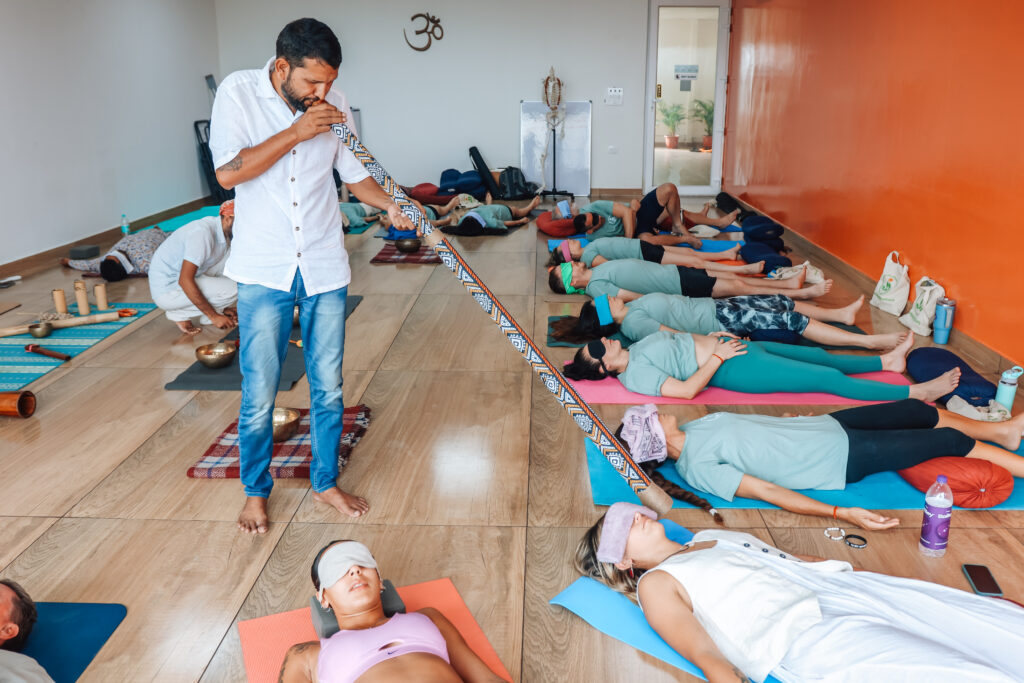
Yoga today has many faces. In studios around the world, we see modern approaches such as somatic yoga or embodied yoga, where movement and body-awareness become the main doorway into practice. These styles are powerful, therapeutic, and deeply supportive in helping us feel safe, present, and connected to our bodies.
And yet, beyond all of this, yoga has another face—the traditional one. Rooted in the wisdom of the great sages, yoga was never only about the body. It was, and still is, a path of liberation, a way of transcending the layers of the physical and mental to realize the truth of who we are.
The Traditional Path: Beyond the Body
The ancient teachings of yoga describe it not as exercise, but as a way of stilling the mind. Patanjali, in the Yoga Sutras, tells us: Yoga is the cessation of the fluctuations of the mind.
In this view, asana (posture) was never the end goal. It was simply preparation—a way to strengthen and purify the body so that one could sit steadily in meditation and journey inward.
Traditionally, yoga is:
-
A spiritual discipline leading us beyond body and mind.
-
A practice that connects us with our highest Self.
-
A wisdom carried through living lineages of realized teachers.
Health, flexibility, and strength arise naturally through yoga, but they are not the final destination. The destination is union, freedom, and self-realization.
The Modern Somatic and Embodied Approach
In today’s world, somatic and embodied yoga offer something fresh and much needed. These practices invite us to listen deeply to the body, to explore movement with curiosity, and to use sensation as a path to healing.
They are powerful because they:
-
Make yoga accessible for everyone.
-
Offer deep healing from trauma, stress, and disconnection.
-
Encourage authentic self-discovery through movement.
For many, this is the first step into yoga. It brings a sense of safety, presence, and wholeness. And in that sense, it is truly valuable.
Where the Essence Can Be Lost
But here lies the risk: if we remain only in the physical or therapeutic dimension, we may forget that yoga points us beyond the body. Without tradition, yoga can easily become just another wellness activity—something that makes us feel good, but does not touch the depth of who we are.
The sages remind us that we are not the body, nor the mind, nor even the emotions. We are the witnessing presence behind them all. If this essence is forgotten, yoga loses its true soul.
Why Rishikesh Holds the Key
There is a reason Rishikesh yoga shala is called the Yoga Capital of the World. Nestled in the lap of the Himalayas, blessed by the sacred river Ganga, this place has carried the vibrations of seekers and saints for centuries.
To practice yoga here is to enter into a living stream of tradition. The energy of the land itself supports deeper practice. Many who come to Rishikesh feel something they cannot explain—a presence, an essence—that they have never felt elsewhere.
It is not just about postures on a mat. It is about connecting with the spirit of yoga in its truest form.
A Living Balance
The way forward is not to choose one path over the other, but to bring them together. The modern somatic approaches can help us heal and reconnect with our bodies. The traditional approach keeps us rooted in yoga’s true purpose—union and freedom.
When we integrate both, yoga becomes complete. It becomes a path that heals the body, calms the mind, and awakens the spirit.
That is the gift of yoga, and that is the essence we must protect.
Frequently Asked Questions:
1. What is the difference between traditional yoga and modern yoga?
Traditional yoga places significant emphasis on self-discipline, meditation, philosophy, and spiritual development. Modern yoga often gives greater attention to physical postures, movement, flexibility, fitness, and overall well-being. Many contemporary approaches combine elements of both traditions.
2. What is the true essence of traditional yoga?
Traditional yoga is a holistic path of personal and spiritual development. It includes ethical principles, physical practices, breathing techniques, concentration, meditation, and self-inquiry. Its deeper aim, particularly in classical philosophical traditions, is to understand the nature of the Self and attain liberation.
3. What is somatic yoga?
Somatic yoga focuses on internal body awareness, mindful movement, and the sensations experienced during practice. It encourages practitioners to move with attention rather than simply concentrating on achieving a particular posture or external shape.
4. What is embodied yoga?
Embodied yoga emphasises experiencing yoga through the body with greater awareness and attention. Practitioners explore movement, breathing, sensation, and the relationship between physical experiences and mental states.
5. What does Patanjali say about the meaning of yoga?
Patanjali’s Yoga Sutras describe yoga through the phrase Yoga Chitta Vritti Nirodhah, commonly translated as the stilling or restraint of the fluctuations of the mind. This teaching highlights the importance of mental discipline and awareness in the practice of yoga.
6. Is yoga only about physical postures and flexibility?
No. Physical postures are one aspect of yoga. Traditional yoga also includes pranayama, meditation, ethical principles, concentration, self-study, and philosophical inquiry. Developing flexibility is not the ultimate purpose of every yoga tradition.
7. Can traditional yoga and modern somatic practices be combined?
Yes. Mindful movement and body awareness can complement traditional yoga practices. Practitioners can explore physical awareness through somatic approaches while also studying pranayama, meditation, yoga philosophy, and traditional ethical teachings.
8. How does meditation contribute to traditional yoga practice?
Meditation helps practitioners develop concentration, mental awareness, and the ability to observe thoughts and emotions. In traditional yoga, meditation is an important part of the inward journey towards deeper self-understanding and spiritual development.
9. Why is Rishikesh considered an important destination for traditional yoga?
Rishikesh is widely recognised for its yoga heritage, spiritual traditions, Himalayan surroundings, and proximity to the River Ganga. It attracts students from different parts of the world who want to explore yoga philosophy, meditation, pranayama, and traditional and contemporary teaching approaches.
10. How can beginners experience the true essence of yoga?
Beginners can start by learning foundational asanas, practising simple breathing techniques, developing mindfulness, and exploring introductory yoga philosophy. Learning under a knowledgeable teacher and practising consistently can help build a balanced understanding of yoga beyond physical exercise.